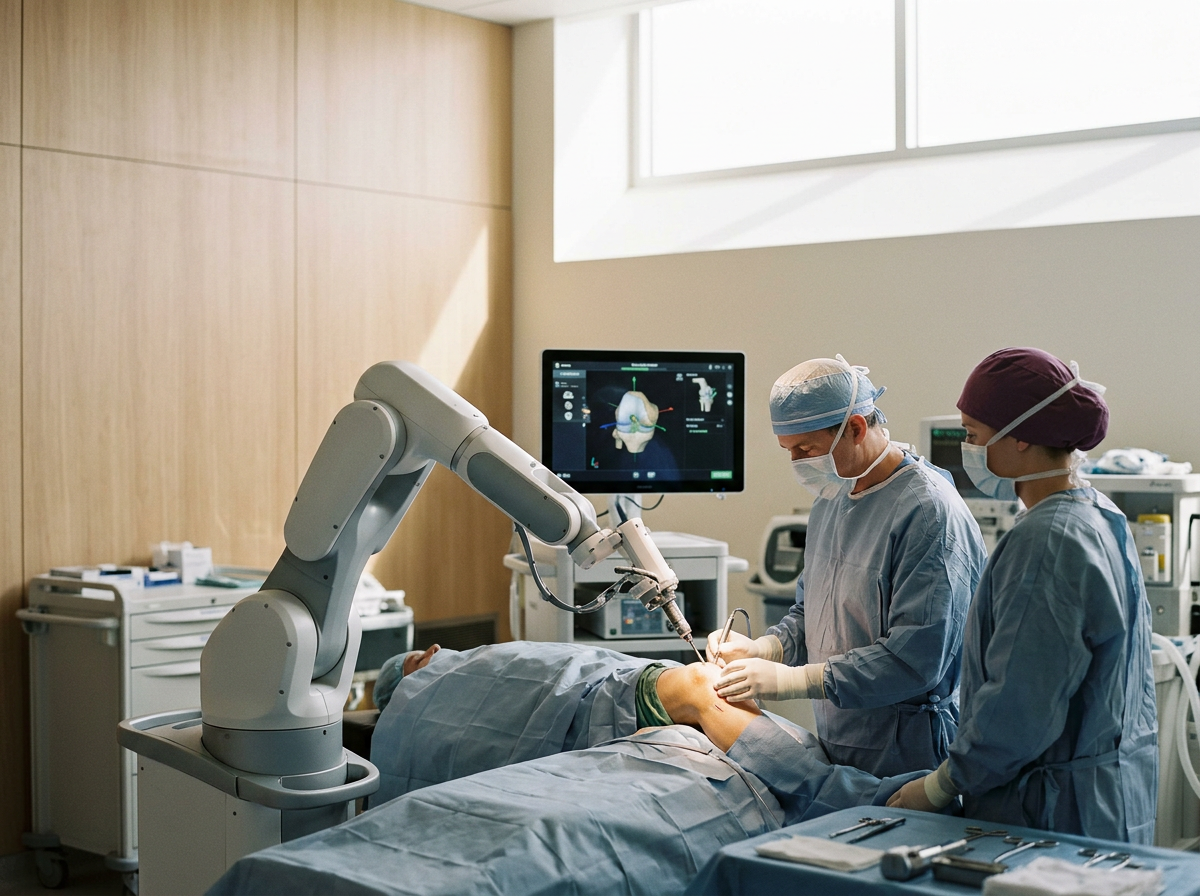
Jiffy Knee Replacement or Subvastus knee replacement
Subvastus Knee Replacement and Jiffy Knee: A Modern Approach to Faster Recovery After Knee Replacement
Knee replacement surgery has evolved significantly over the years, with advances in surgical techniques designed to improve patient comfort, preserve muscle function and support an earlier return to everyday activities. Among these approaches, subvastus knee replacement and the Jiffy Knee technique have attracted considerable attention for their focus on minimising disruption to the muscles around the knee.
For patients living with severe knee arthritis, these techniques may offer an alternative to traditional surgical approaches. However, understanding how they work, their potential benefits and their limitations is essential when deciding on the most appropriate treatment.
What Is a Subvastus Knee Replacement?
A subvastus knee replacement is a surgical approach used during total knee arthroplasty (TKA). Unlike the conventional medial parapatellar approach, which involves an incision through the quadriceps tendon, the subvastus approach accesses the knee joint beneath the vastus medialis muscle, part of the quadriceps muscle group.
The quadriceps muscles play a crucial role in straightening the knee, maintaining stability and enabling activities such as walking, climbing stairs and getting up from a chair.
By avoiding a routine incision through the quadriceps tendon, the subvastus approach aims to preserve the extensor mechanism and reduce disruption to the structures responsible for knee extension.
How Is the Procedure Performed?
During a subvastus knee replacement, the surgeon accesses the knee joint beneath the vastus medialis muscle, rather than splitting the quadriceps tendon as in the traditional medial parapatellar approach.
The damaged joint surfaces are removed and replaced with artificial components designed to restore alignment, stability and function. The procedure may be performed using conventional instrumentation or with the assistance of computer navigation or robotic technology, depending on the surgeon's practice and the patient's requirements.
The choice of surgical approach depends on several factors, including the patient's anatomy, body habitus, previous surgeries, knee deformity and the surgeon's experience.
What Is Jiffy Knee Replacement?
The term Jiffy Knee is commonly used to describe a muscle-sparing approach to total knee replacement that aims to minimise disruption to the quadriceps mechanism and facilitate early postoperative recovery.
It is associated with the concept of performing knee replacement through a less disruptive surgical approach, often using the subvastus technique or related muscle-sparing principles.
It is important to understand that Jiffy Knee is a branded or promotional term rather than a universally standardised medical procedure. The exact surgical technique, instrumentation and rehabilitation protocol may vary between surgeons and practices.
The central principle is to minimise unnecessary trauma to the surrounding soft tissues while accurately positioning the knee replacement components and restoring the knee's function.
Subvastus Knee Replacement vs Traditional Knee Replacement
One of the main differences between these approaches is how the surgeon accesses the knee joint.
Traditional medial parapatellar approach
Provides excellent exposure of the knee joint.
Is widely used and familiar to orthopaedic surgeons.
Involves an incision through the quadriceps tendon and medial retinaculum.
Has a well-established track record across a broad range of patients and knee deformities.
Subvastus approach
Accesses the knee beneath the vastus medialis muscle.
Avoids a routine incision through the quadriceps tendon.
May offer advantages in early quadriceps function and postoperative rehabilitation.
Can provide more limited surgical exposure in selected patients, potentially increasing technical difficulty.
Neither approach is automatically superior for every patient. The priority is to achieve a well-aligned, stable and durable knee replacement while minimising complications.
Potential Benefits of a Muscle-Sparing Knee Replacement
1. Earlier Recovery of Quadriceps Function
Preserving the quadriceps tendon may help patients regain straight-leg raising and active knee extension earlier after surgery. Some studies of the subvastus approach have reported improvements in early quadriceps function compared with the medial parapatellar approach.
However, the degree of benefit varies, and differences may diminish as recovery progresses.
2. Potentially Less Postoperative Pain
Reducing disruption to the extensor mechanism may help limit postoperative pain in some patients. Less pain can make it easier to begin walking, participate in physiotherapy and perform early rehabilitation exercises.
Pain after knee replacement is multifactorial, however, and is also influenced by anaesthesia, perioperative analgesia, surgical technique and individual patient characteristics.
3. Earlier Mobilisation
Patients undergoing a muscle-sparing approach may be able to perform certain rehabilitation milestones earlier, such as straight-leg raising, transferring from a chair and walking with assistance.
Early mobilisation remains a key part of modern knee replacement care, regardless of the surgical approach.
4. Potentially Improved Early Functional Outcomes
Some clinical studies have found improvements in early range of motion, quadriceps strength or functional recovery following the subvastus approach. These findings are not uniform across all studies, and long-term outcomes are generally influenced by multiple factors beyond the surgical approach alone.
5. A Focus on Tissue Preservation
The underlying principle of the subvastus approach is to preserve important soft-tissue structures while allowing accurate implantation of the prosthesis.
The objective is not simply to make the incision smaller, but to achieve an appropriate balance between tissue preservation, surgical visibility, component positioning and long-term implant performance.
Are There Any Limitations or Risks?
Although muscle-sparing approaches have potential advantages, they are not suitable for every patient.
The subvastus approach can be technically demanding and may provide more restricted exposure in patients with severe knee deformity, substantial obesity, previous knee surgery or a large, stiff knee.
Other considerations include:
Potentially longer operative time during the surgeon's learning curve.
Difficulty obtaining adequate exposure in selected cases.
Possible injury or excessive traction to the vastus medialis muscle if the approach is not performed carefully.
The usual risks associated with knee replacement, including infection, blood clots, stiffness, persistent pain, instability and implant-related complications.
A surgeon may reasonably choose a traditional approach when it offers safer exposure and more predictable execution for a particular patient. A less disruptive approach should never compromise the accuracy or safety of the knee replacement.
Who May Be Suitable for a Subvastus or Jiffy Knee Approach?
Patients with symptomatic knee osteoarthritis who have not achieved adequate relief with non-surgical treatments may be candidates for total knee replacement.
A muscle-sparing approach may be considered for selected patients, particularly when the surgeon believes adequate exposure can be achieved without compromising the procedure.
Suitability depends on:
The severity and pattern of arthritis.
The degree of knee deformity and stiffness.
Body habitus and individual anatomy.
Previous knee operations or scars.
General health and rehabilitation requirements.
The surgeon's training and experience with the technique.
The decision should follow a comprehensive clinical assessment, including examination and appropriate imaging.
Does Jiffy Knee Mean a Faster Recovery?
The possibility of faster early recovery is one of the main reasons patients ask about Jiffy Knee replacement.
Preserving the quadriceps mechanism may offer an advantage during the initial postoperative period. Nevertheless, no surgical technique can guarantee a pain-free procedure, immediate independent walking or a faster recovery for every patient.
Recovery depends on several interacting factors, including preoperative muscle strength, overall health, pain management, swelling, physiotherapy participation and the complexity of the operation.
Patients should also distinguish between early recovery milestones and long-term outcomes. Improvements during the first few days or weeks do not necessarily translate into superior long-term function or implant longevity.
The Importance of Surgical Experience and Rehabilitation
The success of knee replacement depends on more than the choice of surgical approach.
Accurate component positioning, appropriate implant selection, balanced soft tissues, infection prevention and a structured rehabilitation programme remain fundamental to achieving a good result.
An experienced orthopaedic surgeon will select the approach that best suits the patient's anatomy and clinical needs rather than applying the same technique to every case.
Following surgery, a personalised rehabilitation programme typically includes progressive walking, knee range-of-motion exercises, quadriceps strengthening and functional training. Appropriate pain management and early mobilisation support the recovery process.
Frequently Asked Questions
Is subvastus knee replacement better than traditional knee replacement?
The subvastus approach may improve some early recovery measures, including quadriceps function and early range of motion, in selected patients. However, evidence does not establish that it is universally superior to the traditional approach. Both can provide excellent outcomes when appropriately selected and performed.
Is Jiffy Knee a different operation from a subvastus knee replacement?
Not necessarily. Jiffy Knee is a branded or promotional term associated with a muscle-sparing knee replacement philosophy. A subvastus approach may form part of the technique, but the precise method can vary. Patients should ask their surgeon exactly which approach will be used.
Will I walk sooner after a Jiffy Knee replacement?
Some patients may achieve early mobility milestones sooner with a muscle-sparing approach. However, the timing of walking independently varies according to individual health, surgical complexity, pain control and rehabilitation progress.
Is the implant different in a Jiffy Knee replacement?
Not necessarily. Jiffy Knee generally refers to the surgical approach and recovery philosophy rather than a single, unique implant. The implant selected depends on the patient's anatomy, bone quality, ligament function and the surgeon's assessment.
Is a muscle-sparing approach suitable for everyone?
No. Certain deformities, previous surgeries and anatomical factors may make a different approach more appropriate. The safest technique is the one that allows the surgeon to perform an accurate and reliable knee replacement for the individual patient.
Conclusion
Subvastus knee replacement and the Jiffy Knee concept reflect an ongoing effort to improve the patient experience following total knee arthroplasty. By focusing on preservation of the quadriceps mechanism and minimising unnecessary soft-tissue disruption, these approaches may offer advantages in early postoperative function and rehabilitation for selected patients.
However, muscle preservation alone does not determine the success of knee replacement. Appropriate patient selection, surgical expertise, accurate implant positioning and a structured rehabilitation programme remain essential.
The best knee replacement approach is the one that prioritises patient safety, reliable surgical outcomes and long-term function. Patients considering knee replacement should discuss the available surgical options with an experienced orthopaedic surgeon to determine which approach is most appropriate for their individual needs.
Disclaimer: This article is intended for general educational purposes and does not replace an individual consultation with a qualified orthopaedic surgeon.